
Blog
Understanding Probability in Hearts Card Game: A Complete Guide to Winning Strategy

The Hearts card game may seem simple at first glance, with straightforward rules about avoiding points, steering clear of hearts, and never getting stuck with the Queen of Spades. These basic rules make Hearts accessible to beginners and explain why it remains one of the most popular card games worldwide. However, once you progress beyond beginner-level play, something fascinating becomes apparent: Hearts is fundamentally built on mathematical probability.
Every hand you play is shaped by chance, yet skilled players consistently outperform others because they understand likelihood, risk assessment, and strategic timing. These players do not sit at the table with calculators doing formal mathematics; they continuously estimate odds and adjust their decisions as new information becomes available with each card played.
Why Mathematical Probability Is Essential to Hearts Card Game Success
Playing Hearts With Incomplete Information: The Core Challenge
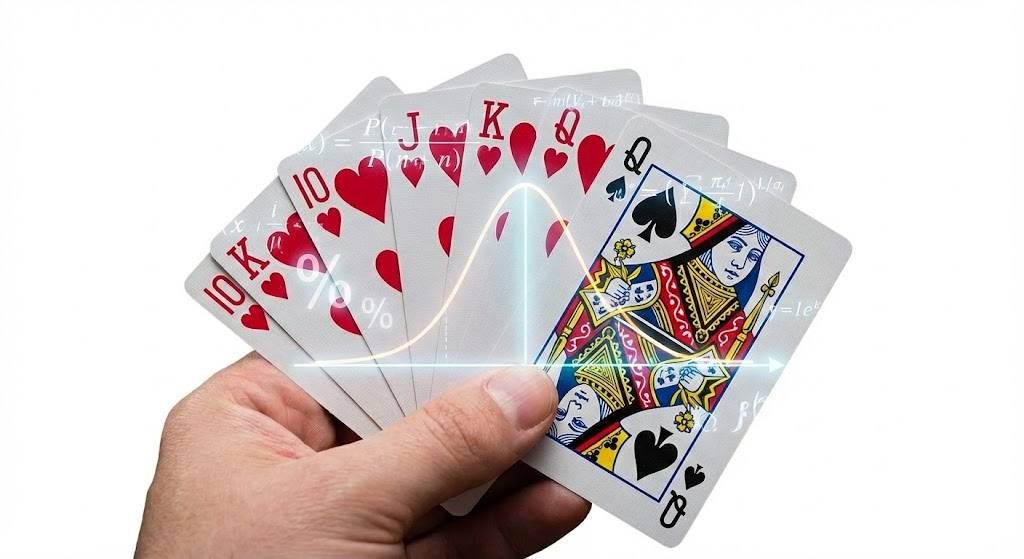
In Hearts, you only see your own 13 cards at the start. The remaining 39 cards are hidden in other players’ hands. From the very first trick onward, every decision you make must account for incomplete information, which is where probability becomes your most valuable tool.
Probability helps bridge this information gap. When a particular suit is led multiple times and certain high cards never appear, the probability increases that someone is intentionally holding them back. When a player discards early in a suit, this signals they have a short suit. These are not wild guesses or hunches; they are probability-based assumptions grounded in mathematical logic.
Hearts game players who pay careful attention to what is missing from play just as much as to what cards have already been played. This awareness forms the foundation of strategic decision-making.
Managing Risk in Hearts: Avoiding Damage Rather Than Seeking Rewards
Unlike many popular card games where players compete to gain advantages and score points, Hearts operates on a fundamentally different principle: minimising damage. Every point you take works against you. This defensive nature makes probability especially critical to long-term success.
A risky move that succeeds once but fails frequently will damage your score over time. Players who consistently choose options with lower long-term risk probability tend to perform better across multiple rounds and games. Success in Hearts comes from steady, probability-informed decisions rather than bold gambles.
Card Distribution and Probability Analysis in Your Starting Hand
How to Read Your Starting Hand Using Probability Principles
The moment you pick up your 13 cards, probability is already working. Your hand distribution reveals important information:
• Having many hearts increases the mathematical probability that you will take points during the hand
• Having few hearts increases your chances of safely dumping them without taking points
• Holding high cards raises your risk if you cannot effectively control when that suit is played
Skilled Hearts players evaluate their hands by overall structure and probability, not just by focusing on individual dangerous cards. This holistic view helps inform your entire strategy for the hand.
Strategic Value of Short Suits in Hearts Probability
Short suits represent one of the most powerful probability advantages in Hearts because they create discard opportunities. When you hold zero or one card in a suit, the odds dramatically increase that you can shed dangerous cards when that suit gets led by another player.
Probability analysis is used when tracking suit distribution across the table. If a particular suit keeps circulating through multiple tricks without breaking, players can reasonably assume someone holds length in that suit, meaning they have many cards of that suit. This probability assessment affects when and how you should play your own cards in response.
Passing Phase: How Probability Shifts the Entire Game
Why Passing Cards Is a Mathematical Decision That Changes Everything
The passing phase is not simply about getting rid of your most dangerous cards. It fundamentally reshapes the probability distribution across the entire table, affecting all four players differently.
When you pass high hearts or the Queen of Spades to an opponent, you reduce your own expected points for the hand. Simultaneously, you increase the uncertainty and risk for other players around the table. Someone else now faces an increased probability of taking points than they did before. This redistribution represents an early probability adjustment that influences the entire remainder of the hand.
Using Probability to Infer What Other Players Received
While you never know exactly which cards your opponents receive during the passing phase, probability principles still apply and provide valuable information. If you passed three hearts to the player on your left, it becomes statistically likely that the player now holds more hearts than before. If you kept low cards in a particular suit, you are mathematically safer when that suit gets led because you have less risk of winning the trick.
In Hearts, small probability changes that occur early in the hand often determine the outcomes of the round. Understanding this principle helps you make better passing decisions.
Expected Value and Long-Term Avoidance Strategy in Hearts
Understanding Expected Value: Thinking in Long-Term Outcomes
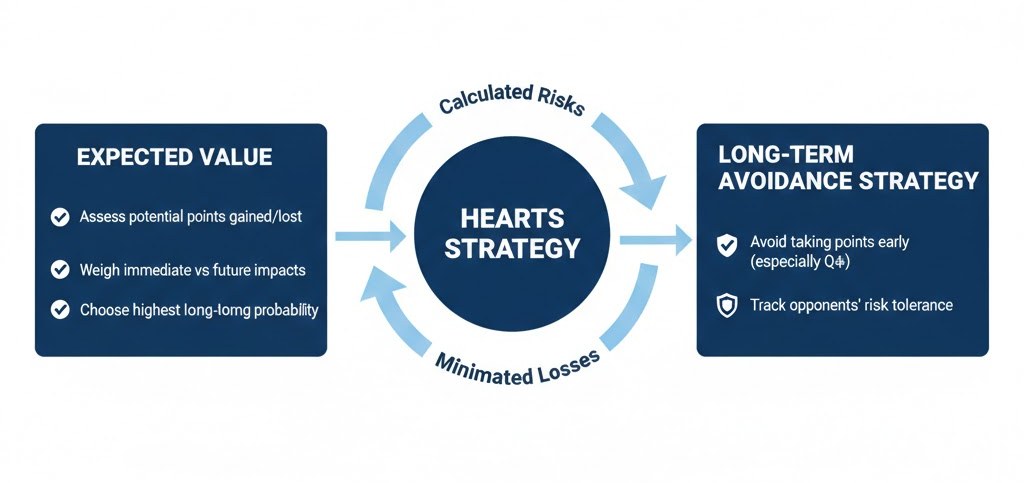
Expected value is a fundamental probability concept that can dramatically improve your Hearts strategy. Rather than focusing on a single lucky or unlucky moment, expected value means analysing the average results across many games and hands.
For example, holding the Queen of Spades may feel safe for the first few tricks of a hand. However, each additional round you continue holding it mathematically increases your probability of disaster. Over many games, this risky choice leads to higher average scores and worse overall performance. Good Hearts players consistently choose moves that reduce their expected points over time, not just their immediate danger in the current trick.
How to Choose Between Bad Options Using Probability
Hearts frequently forces players into uncomfortable situations where all available choices seem bad. Should you take one heart now or risk taking several hearts later? Should you hold onto a high card or dump it early? These dilemmas define the game.
Probability analysis helps frame these difficult decisions more clearly. If many hearts remain unplayed, the real danger lies ahead, and waiting becomes riskier. If most hearts have already been played, the probability of additional risk decreases substantially. You are weighing mathematical likelihood rather than hoping for certainty, which never exists in card games.
Tracking Cards and Updating Probability Throughout the Hand
Paying Attention to Key Information Without Exact Counting
You do not need to maintain exact card counts or memorise every single card played to improve your Hearts game significantly. However, tracking certain key pieces of information provides enormous value.
Knowing whether the Queen of Spades has been played completely changes how you should treat spades for the rest of the hand. Noticing approximately how many hearts have been played affects when you feel safe leading hearts yourself. Every card that gets played reduces the overall uncertainty in the game. The more attention you pay to these developments, the clearer the remaining probability becomes, allowing for better decisions.
Why Pattern Recognition Matters More Than Complex Mathematics
Most successful Hearts players rely on pattern recognition rather than mathematical formulas or detailed calculations. If someone repeatedly avoids leading a particular suit, they probably hold few cards in that suit. If a player keeps discarding high cards early in the hand, they may be preparing for a moon attempt, in which they try to take all 26 points.
These observable patterns serve as practical tools for probability. They help you predict likely behavior and probable card distribution without requiring any complex calculation. Your brain naturally processes these patterns into useful strategic information.
Shooting the Moon in Hearts: Understanding High-Risk Probability
When Probability Supports a Moon Attempt in Hearts
Shooting the moon is the highest-risk, highest-reward scenario in Hearts. The attempt only makes strategic sense when probability calculations strongly support success. Simply wanting to shoot the moon is never enough justification.
You need several key elements: control of critical suits, possession of strong high cards, and the ability to force opponents into taking tricks on your terms. Without these probability-supporting conditions in place, the mathematical odds heavily favour failure. Moon attempts fail most often because players ignore probability analysis and rely on hope or wishful thinking rather than sound mathematics.
How Opponent Reactions Affect Moon Probability
Even when you hold a strong hand with excellent moon potential, your success probability depends heavily on how your opponents respond. If they notice your moon strategy early in the hand, they can block your attempt by intentionally taking a single point, which ruins your chance at all 26 points.
Successful moon attempts usually occur when opponents misread the situation or fail to recognise the danger until it’s too late. Understanding the probability of that misread occurring matters more than your card strength alone. Both elements combine to determine your actual likelihood of success.
Endgame Probability and Strategic Timing in Hearts
How Fewer Cards Create Clearer Probability Outcomes
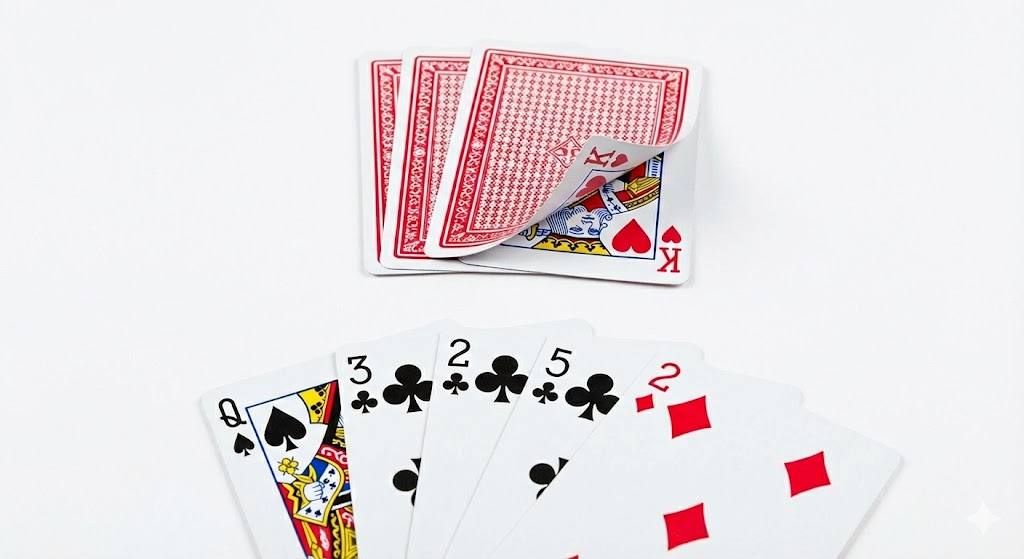
As each hand progresses toward its conclusion, probability calculations become increasingly precise and reliable. With fewer unknown cards remaining, players can predict outcomes with much greater confidence and accuracy.
Late in a Hearts hand, experienced players can often determine who will win each trick before any cards get played. This mathematical clarity allows for much better timing when dumping dangerous cards or carefully avoiding additional points. The shrinking pool of unknown cards makes the probability nearly certain.
Recognising When Probability Shows Safety Has Arrived
Experienced Hearts players develop the crucial skill of knowing when danger has completely passed based on probability. If all 13 hearts have been played or the Queen of Spades has already been captured, the probability of taking additional penalty points shifts dramatically to zero.
At that point, your playing style can and should change completely. Players stop focusing on avoidance and can start actively controlling tricks for strategic purposes. Understanding this probability shift separates good players from great ones.
Probability Versus Emotional Reactions in Hearts Strategy
Avoiding Panic After Bad Tricks: Maintaining Probability Focus
Hearts can feel extremely punishing at times. One unexpected trick, loaded with hearts or catching the Queen of Spades, can ruin an entire round. Emotional reactions to these setbacks typically lead to even worse subsequent decisions.
Maintaining a probability-based perspective helps provide emotional balance and clarity. A single bad trick does not define the overall game or eliminate your chances of a decent score. Overreacting usually increases your risk for the remaining tricks. Calm, probability-informed play tends to recover from setbacks far better than emotional, reactive play.
Why Consistency Wins Matches in Hearts More Than Flashy Plays
Flashy, dramatic plays occasionally win individual hands and provide memorable moments. However, consistent probability-based decisions win matches and tournaments over time. Hearts fundamentally rewards steady, logical thinking over dramatic gambles.
This long-term strategic structure explains why experienced players with a solid understanding of probability often dominate Hearts games over extended periods. Their mathematical approach produces reliable results that compound over dozens of hands.
Why Hearts Card Game Strategy Feels Intellectually Deep
The Hearts card game feels intellectually rich and strategically deep because it constantly balances uncertainty against control. Mathematical probability gives meaningful shape to that uncertainty without ever eliminating it.
You never possess complete information about what opponents hold, yet you are never guessing blindly either. Each card that gets played narrows the range of possibilities. Each trick changes the probability landscape. That dynamic balance between uncertainty and emerging clarity keeps Hearts engaging and fresh even after hundreds of games.
This intellectual depth, grounded in probability theory, explains why Hearts has remained one of the most popular card games for generations of players.
Reference: Essential Probability Concepts for Hearts Players
Basic Probability Principles Every Hearts Player Should Know
• With 52 cards total, you see only 13 cards (25%) at the start, leaving 75% unknown
• Each suit has 13 cards, so the probability of any specific card being in a particular player’s hand is approximately 33% in a 4-player game
• The Queen of Spades accounts for 13 of the 26 total penalty points (50% of all points)
• Each heart represents approximately 3.8% of total penalty points
• Shooting the moon successfully gives opponents 26 points each, making it the highest-impact move
• As cards are played, probability calculations become more accurate due to reduced uncertainty
Strategic Probability Guidelines for Different Game Phases
During the Passing Phase:
• Pass high hearts (10, Jack, Queen, King, Ace) to reduce your expected point total
• Pass the Queen of Spades unless you have strong spade control with Ace and King
• Consider passing high cards from short suits to create void opportunities
• Keep low cards (2, 3, 4, 5) in multiple suits for safe discard options
• Evaluate moon shooting potential before passing away key control cards
During Early Tricks (Tricks 1-4):
• Play low cards when following suit to avoid winning tricks
• Dump the Queen of Spades early if you lack spade protection
• Watch for void suits in other players based on their discards
• Track which high spades have been played to assess Queen of Spades danger
• Establish suit lengths by observing which suits circulate repeatedly
During Middle Tricks (Tricks 5-9):
• Calculate approximately how many hearts remain unplayed
• Identify potential moon shooters by observing consistent trick-winning patterns
• Use void suits strategically to dump high hearts or dangerous cards
• Reassess risk levels as the probability landscape shifts with each played card
• Consider intentionally taking one point to block a suspected moon attempt
During Late Tricks (Tricks 10-13):
• Predict trick outcomes with high accuracy based on remaining known cards
• Aggressively dump remaining high hearts when opportunities arise
• Shift from defensive to offensive play if all penalty cards are accounted for
• Execute precise timing to force opponents into taking remaining points
• Use mathematical certainty to control final trick outcomes
Common Probability Mistakes Hearts Players Make
• Holding the Queen of Spades too long, hoping for a safe discard opportunity
• Attempting moon shots without sufficient high card control or probability support
• Ignoring void suit signals from opponent discards and missing strategic information
• Making emotionally reactive decisions after taking unexpected points
• Failing to adjust strategy as probability changes throughout the hand
• Leading high cards early when holding length in a suit
• Not tracking key cards like high spades and high hearts
• Passing cards randomly without considering a probability-based strategy
Advanced Probability Tactics for Experienced Players
• Count suits to determine void probabilities and predict opponent hands
• Use conditional probability to adjust expectations based on revealed information
• Calculate expected value for risky plays before committing to a strategy
• Employ game theory principles to anticipate rational opponent responses
• Recognise statistical patterns in opponent behavior over multiple hands
• Use Bayesian updating to refine probability estimates as new cards appear
• Master the art of reading table dynamics and psychological probability factors
Further Reading and References on Card Game Probability
Academic and Mathematical Resources
• Packel, Edward W. “The Mathematics of Games and Gambling” (2006) – Provides foundational probability theory applicable to card games, including trick-taking games like Hearts
• Epstein, Richard A. “The Theory of Gambling and Statistical Logic” (2009) – Comprehensive coverage of probability theory in competitive games with incomplete information
• Bewersdorff, Jörg. “Luck, Logic, and White Lies: The Mathematics of Games” (2021) – Explores mathematical principles underlying card games and strategic decision-making
• Ross, Sheldon. “A First Course in Probability” (2019) – Standard probability textbook with applications to card games and conditional probability
• Hannum, Robert C. and Cabot, Anthony N. “Practical Casino Math” (2005) – Discusses expected value calculations applicable to various gaming scenarios
Card Game Strategy Resources
• Parlett, David. “The Penguin Book of Card Games” (2008) – Comprehensive guide to card game rules and strategies, including detailed Hearts analysis
• Morehead, Albert H. and Mott-Smith, Geoffrey. “Hoyle’s Rules of Games” (2001) – Classic reference covering traditional card game strategies and probability considerations
• Seymour, Richard. “Winning Hearts Strategy” – Online resource focusing specifically on advanced Hearts tactics and probability-based play
• United States Playing Card Company. “Official Rules of Card Games” – Authoritative source for standardised Hearts rules and competitive play guidelines
Online Resources and Communities
• CardGames.io and similar online Hearts platforms – Provide practical experience against varied opponents and AI with different probability-based strategies
• BoardGameGeek Hearts Strategy Forums – Active community discussions on probability applications and advanced tactics
• Reddit r/cardgames community – Regular strategy discussions and probability analysis from experienced players
• Mathematics Stack Exchange – Technical discussions of probability calculations specific to Hearts scenarios
Related Game Theory and Decision-Making Literature
• Von Neumann, John and Morgenstern, Oskar. “Theory of Games and Economic Behavior” (1944) – Foundational game theory text relevant to competitive card game strategy
• Kahneman, Daniel. “Thinking, Fast and Slow” (2011) – Explores cognitive biases that affect probability assessment and decision-making in uncertain situations
• Dixit, Avinash K. and Nalebuff, Barry J. “The Art of Strategy” (2008) – Practical game theory applications, including strategic thinking in competitive games
• Silver, Nate. “The Signal and the Noise” (2012) – Discusses probability forecasting and updating beliefs with new information, directly applicable to Hearts play
Computer Science and AI Approaches to Hearts
• Sturtevant, Nathan R. and White, Adam M. “Feature Construction for Reinforcement Learning in Hearts” (2006) – Academic research on optimal Hearts strategies using computational methods
• Fujita, Kohei and Ishii, Shin. “Model-Free Reinforcement Learning for Card Games” – Research on AI learning optimal probability-based Hearts strategies
• Microsoft Research Hearts AI Projects – Various technical papers on developing competitive Hearts AI using probability calculations and machine learning
Note: These references provide a deeper exploration of probability theory, strategic thinking, and mathematical decision-making that enhance Hearts’ gameplay. Readers interested in advancing their understanding should explore both practical strategy guides and theoretical probability resources to develop comprehensive skills.